Major innovations often start small.
Not in the lab. Not in the conference room.
But in an unassuming corner amid cables, tools, and a persistent question:
Why do we still accept geometric length differences in stranding?
In classic 6+1 stranding, the problem is inherent to the system:
The core wire runs linearly in the center, while the six outer wires are wound in a helical pattern.
Physically, this means that the outer wires travel a significantly longer path due to the winding.
In practice, however, all wires run at the same feed rate.
The consequence: The outer wires are mechanically stretched to compensate for the missing length.
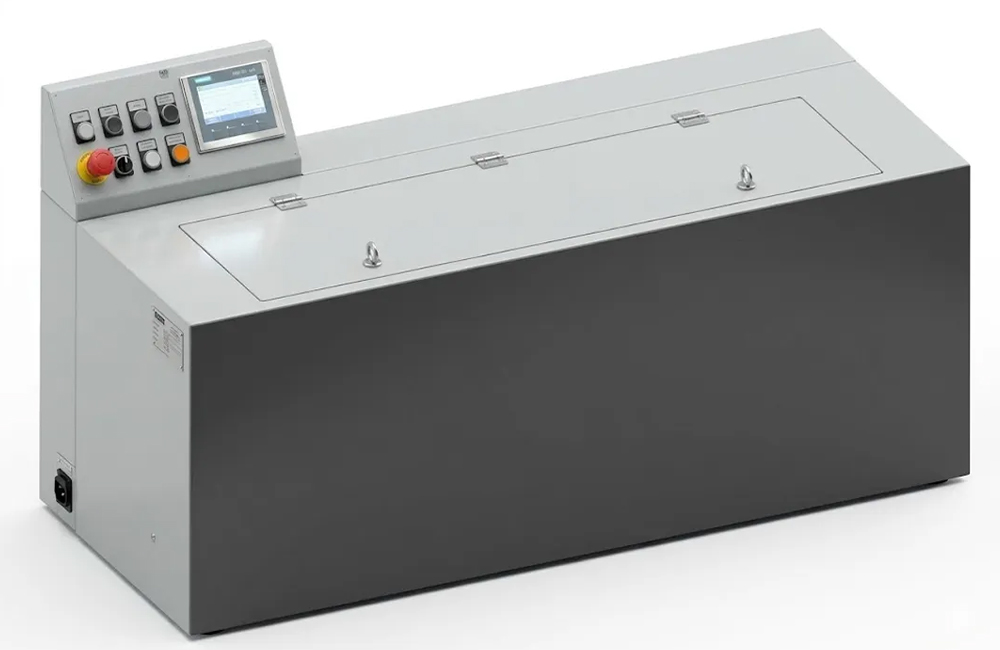
Our answer: the SP-B-500 box accumulator.
It introduces a crucial principle into the process: decoupling instead of forcing.
The core wire is held in the box accumulator as a highly dynamic buffer and precisely controlled.
This allows its speed to be specifically decoupled from that of the outer wires.
The result:
The outer wires receive exactly the length they need geometrically, without mechanical stress.
A controlled, tension-stable core (“Controlled Core”) is created at the center, serving as a reference for the entire stranded wire structure.
The effects are measurable along the entire process chain:
✔️ Consistent conductor cross-section → stable impedance along the entire length
✔️ Minimized reflections → reliable high-frequency performance
✔️ High geometric symmetry → better extrusion and processing properties
✔️ Smoother process → less scrap and higher reproducibility
And all this in a minimal installation space, thanks to a sophisticated storage system that efficiently and compactly buffers long lengths of wire.
What used to be an unavoidable trade-off is now resolved for the first time.
Sometimes all it takes is a corner and the determination not to accept physics, but to control it deliberately.
We are presenting the SP-B-500 box accumulator for the first time at Wire 2026 in Düsseldorf.
📍Hall 10, Booth C18