

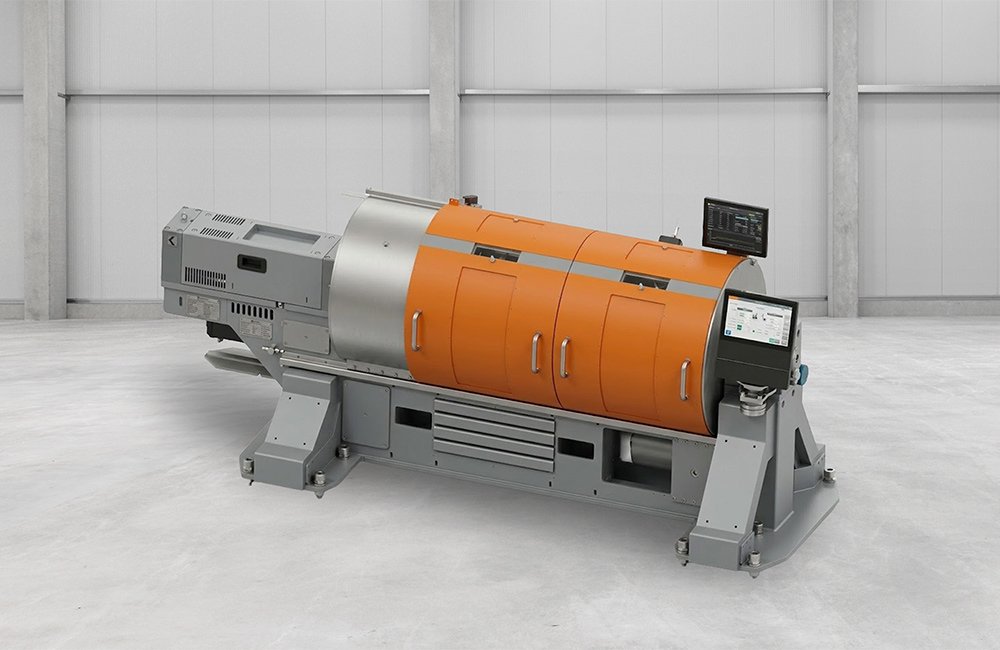
Precision, Process Reliability and Flexibility in Film Processing
Reliable banding of film reels and cross-wound spools requires reproducible processes and precise tension control to ensure consistent product quality.
With the KURRE B-2000 Taping System, manufacturers benefit from a high-performance solution specifically developed to meet the demands of modern production environments. The machine processes film widths from 5 to 50 mm on film reels and 5 to 30 mm on cross-wound spools, covering a wide range of applications.
Two features in particular distinguish the B-2000. The machine processes film widths of up to 50 mm while reaching speeds of up to 1,100 rpm. Combined with pneumatic tension control, this capability represents a distinctive competitive advantage. To the best of our current knowledge, no competing product offers this film width at a comparable speed with pneumatic tension control. At the same time, tension can be precisely controlled within a range of 3 to 50 N, allowing even demanding products to be taped gently and reliably.
- Processing of film reels with diameters of up to 500 mm and cross-wound spools with diameters of up to 300 mm.
- Flexible overlap settings from 0 to 70% to meet varying product requirements.
- Servo-driven taping head and film reel drives ensure maximum precision and repeatability.
- Siemens ET200SP control system with TP1500 Comfort Pro touch panel and comprehensive visualization of key process parameters.
- Optional active tension measurement with automatic closed-loop control for consistently high taping quality.
Another highlight is the camera-based system for monitoring taping quality. It detects deviations in the set parameters, such as insufficient overlap or an incorrect pitch, as well as folded film, and prevents continued production with faulty parameters. This makes an important contribution to process reliability, especially when one operator supervises several machines and the taping system operates temporarily without direct operator supervision.
Product-specific settings can be determined during commissioning and stored as machine recipes. This enables rapid changeovers between different products while ensuring consistent quality across all production batches.
The result is reduced scrap rates, increased process stability, and cost-efficient production combined with maximum flexibility.